
rsteelesr79
Get A Cash Offer For Your House
Get A Cash Offer For Your House
If you need to sell your home quickly and without the usual headaches of traditional real estate sales, getting a **cash offer for your house** is the fastest, simplest solution. At CanSellYourHouse.com, we specialize in providing homeowners in Richmond, VA, and surrounding areas with fair, no-obligation cash offers — often within 24 hours.
**Get a fair cash offer today! Call us or fill out our form.**
—
## Why Choose a Cash Offer for Your House?
Selling a home traditionally can take months, involving inspections, repairs, showings, and uncertainty. A **cash offer for your house** eliminates many of these delays and complications:
– **Fast Closing**: Cash buyers can close in as little as 7 days.
– **No Repairs Needed**: Sell your house as-is — no costly fixes.
– **No Commissions or Fees**: Skip realtor commissions and hidden costs.
– **Certainty**: Cash deals reduce the risk of buyer financing falling through.
Our process is designed to make selling your house in Richmond, VA, simple and stress-free. Whether you’re facing foreclosure, dealing with an inherited property, relocating, or just want to sell quickly, we’re here to help.
—
## How to Get a Cash Offer for Your House
Getting a cash offer from CanSellYourHouse.com is straightforward:
### 1. Contact Us
Reach out by phone or fill out our online form with some basic information about your property.
### 2. Property Evaluation
We review your details and schedule a quick, no-obligation property assessment.
### 3. Receive Your Cash Offer
Within 24 hours, we present a fair, competitive cash offer based on current market values and your home’s condition.
### 4. Accept and Close
If you accept, we coordinate a closing date that works for you—often in under two weeks.
—
## Benefits of Selling Your House for Cash in Richmond, VA
Richmond’s real estate market is unique, and our local expertise ensures you get the best deal possible.
### Local Market Knowledge
We understand Richmond’s neighborhoods, market trends, and property values—allowing us to offer competitive prices that reflect your home’s true worth.
### Avoiding Market Fluctuations
In a fluctuating market, waiting for a traditional sale can be risky. A cash offer provides stability and certainty.
### Simplified Process
Local closings mean faster title searches and paperwork processing, so you can move on quickly.
—
## What Types of Properties Qualify for a Cash Offer?
We buy houses in all conditions across Richmond and nearby areas, including:
– Single-family homes
– Condos and townhouses
– Inherited properties
– Fixer-uppers and distressed homes
– Properties with liens or code violations
No matter the situation, we provide a fair cash offer tailored to your needs.
—
## Common Reasons Homeowners Seek Cash Offers
Many homeowners turn to cash buyers because they:
– Need to avoid foreclosure
– Are relocating for work or family
– Own unwanted inherited property
– Want to avoid costly repairs
– Are tired of the traditional listing process
If any of these sound familiar, a cash offer might be the best solution for you.
—
## Start Your Cash Offer Journey Today
Don’t let the stress of selling your home weigh you down. At CanSellYourHouse.com, we make it easy to get the cash you need without delay.
**Get a fair cash offer today! Call us or fill out our form.**
For more information on selling your home fast, visit our main resource page: [Sell My House Fast](/sell-my-house-fast).
—
## Local Expertise You Can Trust
As a trusted home buyer in Richmond, VA, CanSellYourHouse.com has helped countless homeowners sell quickly and confidently. Our commitment to transparent, fair deals and personalized service sets us apart.
We’re proud to serve Richmond and the surrounding areas with integrity and professionalism.
—
## Frequently Asked Questions (FAQ)
### How quickly can I get a cash offer for my house?
We typically provide a cash offer within 24 hours of receiving your property details.
### Do I need to make repairs before selling?
No. We buy houses as-is, saving you time and money on repairs.
### Are there any fees or commissions?
No. We don’t charge commissions or hidden fees. The offer we make is the amount you’ll receive (minus any closing costs).
### What if my house has liens or outstanding debts?
We can still make you a cash offer and help navigate any title issues.
### Is the cash offer binding?
Our offers are no-obligation. You decide whether to accept or walk away.
—
For a quick, fair cash offer for your house in Richmond, VA, contact CanSellYourHouse.com today and experience a hassle-free home sale.
[Get your cash offer now!](#)
Call us or fill out our form to get started.
“`
How to Price a House For Sale
How to Price a House for Sale: The Complete Guide for Homeowners
Pricing a home correctly is one of the most important steps when selling real estate. If you set the price too high, your home may sit on the market for months without attracting serious buyers. If the price is too low, you may lose thousands of dollars in potential profit.
Understanding how to price a house for sale requires analyzing market conditions, comparable properties, buyer demand, and the condition of the home itself.
In today’s real estate market, buyers have access to more information than ever before. They can compare listings online instantly and determine whether a home is fairly priced. That means sellers must be strategic when deciding what price to list their property at.
This guide explains everything homeowners need to know about pricing their home to sell quickly while maximizing value.
Why Pricing Your House Correctly Is So Important
The first few weeks after listing your home are critical. This is when your property receives the most attention from buyers, real estate agents, and online search platforms.
Homes that are priced correctly often:
- Sell faster
- Receive more showing requests
- Generate multiple offers
- Require fewer price reductions
On the other hand, homes that are overpriced often remain on the market for long periods of time. As time passes, buyers may assume something is wrong with the property, even if the issue is simply the price.
Correct pricing helps your home stay competitive and attractive to potential buyers.
Understanding Market Value
Market value is the price that a buyer is willing to pay and a seller is willing to accept in the current market.
Many homeowners assume their home is worth a certain amount because of personal attachment or past improvements. However, buyers determine value based on comparable sales and current market conditions.
Market value is influenced by several factors, including:
- Location
- Home size and layout
- Condition and upgrades
- Neighborhood demand
- Local housing supply
Understanding these factors is the foundation for determining the right listing price.
Step 1: Study Comparable Sales (Comps)
One of the most effective ways to determine a home’s value is by analyzing comparable sales, commonly referred to as “comps.”
Comparable homes are properties that:
- Recently sold
- Are located in the same neighborhood
- Have similar square footage
- Offer similar features and upgrades
By reviewing these sales, you can estimate what buyers are currently willing to pay.
For example:
If three homes similar to yours sold recently for:
- $345,000
- $350,000
- $355,000
Your home’s estimated value may fall within that range.
Most buyers and real estate agents rely heavily on comparable sales when evaluating whether a home is priced fairly.
Step 2: Understand Current Market Conditions
Real estate markets constantly shift between two major conditions:
Seller’s Market
A seller’s market occurs when there are more buyers than homes available.
In this situation:
- Homes sell quickly
- Buyers compete for properties
- Sellers can sometimes price slightly higher
Buyer’s Market
A buyer’s market occurs when there are more homes for sale than buyers.
In these conditions:
- Buyers have more options
- Sellers must price competitively
- Homes may take longer to sell
Knowing whether your local market favors buyers or sellers helps determine how aggressive your pricing strategy should be.
Step 3: Evaluate Your Home’s Condition
The condition of a home significantly affects its value.
Buyers are willing to pay more for homes that are:
- Updated
- Move-in ready
- Well maintained
If your home requires repairs or renovations, buyers may expect a lower price.
Common factors that influence value include:
- Age of the roof
- HVAC system condition
- Kitchen upgrades
- Bathroom updates
- Flooring quality
- Curb appeal
Small improvements like fresh paint, landscaping, and minor repairs can make a big difference when determining your listing price.
Step 4: Consider the Location
Real estate professionals often say that location is the most important factor in property value.
Homes located near desirable amenities often command higher prices, including:
- Highly rated schools
- Shopping centers
- Public transportation
- Employment hubs
- Parks and recreational areas
Even within the same city, property values can vary significantly depending on neighborhood demand.
If your home is located in a highly desirable area, you may be able to price it higher than comparable homes in less desirable locations.
Step 5: Analyze Your Competition
When selling a home, you are competing with every other listing in your area.
Buyers often compare multiple properties before making a decision. If several homes with similar features are priced lower than yours, buyers will likely choose those options first.
Before listing your home, study competing properties and ask:
- How many homes are currently for sale nearby?
- What prices are they listed at?
- How long have they been on the market?
Understanding the competition helps ensure your home is priced attractively.
Step 6: Decide How Quickly You Need to Sell
Your timeline can influence pricing strategy.
If you need to sell your home quickly, pricing slightly below market value may generate more interest and lead to faster offers.
Some homeowners need to sell quickly due to situations such as:
- Job relocation
- Financial hardship
- Inherited property
- Divorce
- Foreclosure concerns
In these cases, pricing competitively or working with alternative home buyers may help speed up the process.
Step 7: Avoid Overpricing Your Home
Overpricing is one of the most common mistakes sellers make.
Many homeowners believe they can start with a high price and reduce it later if necessary. However, this strategy often backfires.
When a home stays on the market too long:
- Buyers may lose interest
- Agents may stop showing the property
- The listing becomes “stale”
Eventually, sellers often reduce the price multiple times and end up selling for less than they would have if the home had been priced correctly from the start.
Step 8: Consider the Timing of Your Listing
Seasonal trends can also influence pricing and demand.
Traditionally, the best time to list a home is during:
- Early spring
- Late spring
- Early summer
During these periods, more buyers actively search for homes.
However, homes can still sell successfully during other times of the year. In some markets, lower inventory during fall or winter can actually benefit sellers.
Step 9: Understand Buyer Expectations
Modern buyers often prioritize certain features when searching for homes.
These include:
- Updated kitchens
- Open floor plans
- Energy-efficient appliances
- Modern bathrooms
- Storage space
If your home lacks these features, buyers may factor renovation costs into their offers.
Pricing your home with buyer expectations in mind can help attract more interest.
Step 10: Prepare the Property Before Listing
Preparing your home properly can increase its perceived value.
Before listing your property, consider:
- Deep cleaning the interior
- Decluttering living spaces
- Improving curb appeal
- Repairing visible issues
- Staging key rooms
First impressions matter. A well-maintained home often sells faster and closer to the asking price.
Step 11: Adjust the Price if Necessary
Even with careful planning, you may need to adjust your price after listing.
Common signs that your home may be overpriced include:
- Few showing requests
- Little online interest
- Negative buyer feedback
- Nearby homes selling faster
A strategic price reduction can renew buyer interest and improve the chances of receiving offers.
The Role of Appraisals and Inspections
In most home sales, buyers will order a professional appraisal to determine the property’s value.
If the appraisal comes in lower than the agreed purchase price, the buyer’s lender may refuse to finance the deal.
Because of this, it is important to price your home realistically based on market data.
Home inspections also play a role in negotiations. If inspections reveal issues, buyers may request price reductions or repairs.
Alternative Options for Selling Your House
Some homeowners choose to sell through traditional real estate listings. Others may explore faster selling options.
Situations where alternative selling options may make sense include:
- Homes needing major repairs
- Properties with tenant issues
- Inherited homes
- Financial hardship
- Foreclosure risk
Some companies specialize in buying houses directly, which can eliminate the need for repairs, showings, and long waiting periods.
Final Thoughts: Pricing Your Home the Right Way
Learning how to price a house for sale requires a combination of research, market awareness, and realistic expectations.
By analyzing comparable sales, studying the local market, and evaluating the condition of your home, you can determine a price that attracts buyers while protecting your equity.
Correct pricing not only helps your home sell faster but also increases the likelihood of receiving strong offers.
Need to Sell Your House Quickly?
If you want to avoid repairs, showings, or long waiting periods, there may be faster options available.
At CanSellYourHouse.com, we help homeowners explore solutions when they need to sell quickly due to situations like:
- Foreclosure
- Divorce
- Inherited property
- Job relocation
- Problem tenants
- Homes that need major repairs
Visit cansellyourhouse.com to learn more about your options.
SEO Settings for WordPress
SEO Title
How to Price a House for Sale (2026 Guide to Pricing Your Home Right)
Meta Description
Learn how to price a house for sale using comps, market trends, and expert strategies so you can sell your home faster and maximize its value.
Focus Keyword
how to price a house for sale
Slug
how-to-price-a-house-for-sale
If you want, I can also show you something extremely powerful for your site:
I can build you a 20-article SEO cluster for cansellyourhouse.com that targets motivated seller searches like:
- sell my house fast
- how to stop foreclosure
- selling inherited house
- selling house with tenants
- sell house needing repairs
This is exactly how investor websites start ranking and generating seller leads.
The Ultimate Guide: How to Sell Your House Fast
The Ultimate Guide: How to Sell Your House Fast
Proven Strategies to Sell Quickly Without Leaving Money on the Table
Selling a home is one of the biggest financial transactions most people will ever make. In a perfect world, homeowners would have plenty of time to prepare their property, wait for the ideal buyer, and negotiate the highest possible price.
But life doesn’t always work that way.
Sometimes you need to sell quickly.
You may be relocating for a job, facing financial pressure, going through a divorce, dealing with inherited property, or simply ready to move on to the next chapter of your life.
The good news is that selling your house fast is absolutely possible—if you follow the right strategy.
Many homes sit on the market for months because sellers make critical mistakes like overpricing, poor marketing, or failing to prepare the property properly. The fastest sales happen when homeowners understand what buyers want and position their home to stand out immediately.
The core principle of selling quickly is simple:
Your home must be the most attractive, best-priced, and easiest-to-buy property in your local market.
This guide will walk you step-by-step through the process—from preparation to closing—so you can sell your home faster and with less stress.
Part 1: The Pre-Listing Sprint
Why the First 72 Hours Matter Most
The biggest mistake homeowners make when trying to sell quickly is rushing to list the property before preparing it properly.
Your home’s first few days on the market are the most important.
This is when the largest number of buyers will see the listing online. If your home is priced incorrectly or poorly presented during this time, you could lose the momentum that creates quick offers.
Proper preparation dramatically increases your chances of attracting serious buyers immediately.
Step 1: Price It to Sell, Not to Sit
Pricing strategy is the single most important factor in how quickly a home sells.
According to real estate data, overpriced homes typically sit on the market far longer and eventually sell for less than homes priced correctly from the start.
When buyers see a home sitting for weeks without selling, they assume something must be wrong with it.
Get a Comparative Market Analysis (CMA)
A Comparative Market Analysis compares your home to similar properties recently sold in your area.
This report examines factors like:
- Square footage
- Number of bedrooms and bathrooms
- Lot size
- Neighborhood demand
- Condition of the home
- Recent comparable sales
A local real estate professional can provide a CMA that gives you a realistic view of your home’s value.
The “Slightly Under Market” Strategy
If speed is your priority, many experienced sellers use a strategy of pricing the home 1–3% below market value.
This creates immediate buyer interest and can lead to multiple offers competing for the property.
In many cases, this strategy results in the final sale price reaching or exceeding market value because multiple buyers compete for the home.
Avoid the “Test the Market” Trap
Some homeowners start with a high price to “see what happens.”
This almost always backfires.
When a home sits on the market too long, buyers begin to think:
- Something must be wrong with the house
- The seller is unrealistic
- The home might need major repairs
Price reductions later can signal desperation, which weakens your negotiating position.
A strong launch price creates urgency.
Step 2: The 3 D’s of Fast Home Sales
Declutter, Depersonalize, Deep Clean
Buyers need to imagine themselves living in your home.
If the space is cluttered or filled with personal items, it becomes harder for them to picture their own life there.
Preparing your home properly can make it feel larger, brighter, and more appealing.
Declutter Ruthlessly
Go room by room and remove anything that isn’t essential.
A good rule is to remove at least half of the visible items in each room.
Focus on clearing:
- Kitchen counters
- Bathroom vanities
- Shelves and bookcases
- Closets and storage areas
Buyers often open closets during showings. A packed closet makes the entire home feel like it lacks storage.
Consider renting a temporary storage unit during the selling process.
Depersonalize the Space
Take down personal items such as:
- Family photos
- Children’s artwork
- Personal collections
- Unique decorations
Remember, you’re not selling your memories.
You’re selling a future lifestyle for the buyer.
Deep Clean Everything
A spotless home signals that the property has been well maintained.
Professional cleaners can make a major difference.
Focus on:
- Windows and window tracks
- Baseboards and trim
- Kitchen appliances
- Bathroom grout
- Carpets and floors
- Light fixtures and ceiling fans
A clean home photographs better and leaves a stronger impression during showings.
Step 3: High-Impact Improvements That Don’t Break the Bank
You don’t need a major renovation to sell your home quickly.
Instead, focus on small upgrades that create big visual improvements.
Fresh Neutral Paint
Painting is one of the most powerful ways to transform a home.
Choose neutral colors such as:
- Soft gray
- Warm beige
- Light taupe
- Off-white
Neutral colors make rooms feel larger and allow buyers to imagine their own furniture and style.
Fix the Small Problems
Minor issues can create doubt in buyers’ minds.
Repair things like:
- Leaky faucets
- Loose door handles
- Cracked tiles
- Squeaky doors
- Burned-out light bulbs
Small repairs show that the home has been cared for.
Upgrade Simple Fixtures
Replacing outdated fixtures can modernize a home instantly.
Consider updating:
- Cabinet handles
- Light fixtures
- Bathroom faucets
- Door hardware
These improvements often cost a few hundred dollars but significantly increase perceived value.
Step 4: Create Powerful Curb Appeal
Buyers often decide whether they like a home before they even step inside.
Many will drive by the property first.
First impressions matter.
Simple improvements can make your home look more inviting immediately.
Quick Curb Appeal Fixes
- Power wash the driveway and siding
- Mow the lawn and trim hedges
- Add fresh mulch to flower beds
- Plant colorful flowers near the entrance
- Paint the front door
- Install modern house numbers
- Replace the welcome mat
Your goal is to create a welcoming, well-maintained appearance.
Part 2: Your Sales Strategy
How to Attract Serious Buyers Quickly
Once your home is ready, the next step is getting it in front of as many qualified buyers as possible.
Today’s buyers begin their search online, which means your listing must stand out immediately.
Step 1: Choose the Right Selling Method
There are several ways to sell a home quickly, depending on your priorities.
Traditional Sale with a Real Estate Agent
Working with a professional agent remains the most common way to sell a home.
Advantages include:
- Access to the MLS (Multiple Listing Service)
- Professional marketing exposure
- Negotiation expertise
- Guidance through the closing process
For many homeowners, this is the best balance between speed and price.
For Sale By Owner (FSBO)
Some sellers choose to sell their homes without an agent.
While this can save on commission, it often requires:
- Marketing knowledge
- Negotiation experience
- Time to coordinate showings
For inexperienced sellers, this process can take longer.
Cash Buyers and Home Buying Companies
If speed is your top priority, cash buyers may be the fastest solution.
Many companies and investors specialize in buying homes quickly.
Benefits include:
- No repairs required
- No showings
- No financing delays
- Fast closing (sometimes in 7–14 days)
This option may result in a lower sale price but provides maximum convenience.
If you want to explore this option, you can request a no-obligation offer at
Step 2: Professional Photography Is Essential
In today’s digital world, buyers usually see your home online first.
Listings with professional photography receive significantly more attention than those with smartphone pictures.
Professional photographers know how to:
- Use lighting to make rooms feel brighter
- Capture wide angles that show space
- Highlight key selling features
Homes with strong visuals receive more clicks, more showings, and often faster offers.
Consider adding:
- Video tours
- Drone photography
- 3D walkthroughs
These features help buyers explore the property before scheduling a visit.
Step 3: Write a Listing That Sells the Lifestyle
A strong listing description should highlight the benefits of living in the home, not just the features.
Instead of simply listing square footage, focus on how the property improves daily life.
Examples of attractive phrases include:
- Move-in ready
- Updated kitchen
- Open concept living
- Spacious backyard
- Home office space
- Quiet neighborhood
- Energy-efficient upgrades
Buyers often skim listings quickly, so clear and compelling language helps your property stand out.
Step 4: Make Showings Easy
The easier it is for buyers to view your home, the faster it will sell.
Try to accommodate as many showing requests as possible.
Tips for Successful Showings
- Accept last-minute appointments when possible
- Leave the house during showings
- Take pets with you
- Keep the home tidy at all times
Buyers should feel comfortable exploring the property without feeling rushed.
A relaxed showing environment encourages stronger offers.
Part 3: From Offer to Closing
Keeping the Sale on Track
Receiving an offer is exciting, but the process isn’t finished yet.
Many deals fall apart between the offer and closing stages.
The goal now is to maintain momentum and avoid delays.
Consider a Pre-Listing Inspection
A home inspection before listing can identify issues early.
This allows you to:
- Fix problems ahead of time
- Disclose issues honestly
- Prevent surprise negotiations later
Many buyers appreciate transparency and feel more confident making an offer.
Prepare Your Documents Early
Gather important paperwork before the sale progresses.
This may include:
- Mortgage payoff information
- Property tax records
- Utility bills
- Receipts for recent repairs or upgrades
- Warranties for appliances or roofing
Having these documents ready helps prevent delays during closing.
Evaluate Offers Carefully
The highest price isn’t always the best offer.
Pay attention to:
Cash Offers
Cash buyers eliminate financing delays and typically close faster.
Pre-Approved Buyers
A mortgage pre-approval letter indicates the buyer has already been vetted by a lender.
Fewer Contingencies
Offers with fewer conditions often close more smoothly.
Respond Quickly to Requests
During the closing process, several parties will request information:
- Buyer’s agent
- Mortgage lender
- Title company
- Home inspector
Quick responses help keep the transaction moving forward.
Communication delays are one of the most common causes of postponed closings.
When Speed Is Your Top Priority
In some situations, waiting for a traditional buyer simply isn’t practical.
Common reasons homeowners need to sell quickly include:
- Job relocation
- Foreclosure prevention
- Divorce
- Inherited property
- Major repairs needed
- Financial hardship
In these cases, working with a direct home buyer may be the simplest solution.
You can receive a fast, no-obligation cash offer at
Many homeowners choose this option because it eliminates:
- Repairs
- Commissions
- Showings
- Long waiting periods
The Ultimate “Sell It Fast” Checklist
Use this checklist to prepare your home for a fast sale.
Pre-Listing Preparation
✔ Get a comparative market analysis
✔ Price your home competitively
✔ Declutter every room
✔ Remove personal items and photos
✔ Deep clean the entire house
✔ Apply fresh neutral paint if needed
✔ Repair small maintenance issues
✔ Improve curb appeal
Marketing and Showings
✔ Hire a professional photographer
✔ Write a compelling listing description
✔ Market the property online
✔ Be flexible with showing times
✔ Keep the house clean and ready
Closing Preparation
✔ Gather property documents
✔ Consider a pre-listing inspection
✔ Evaluate offers carefully
✔ Respond quickly to communication
✔ Work with professionals to finalize the closing
Final Thoughts
Selling a home quickly doesn’t have to be stressful.
With the right strategy, preparation, and pricing, many homes can sell within days or weeks.
The key is understanding what buyers want and presenting your home in the best possible light.
However, if you need to sell even faster—or want to avoid repairs, showings, and commissions—there are additional options available.
You can explore those options by visiting:
There, you can request a fast, no-obligation cash offer and learn how to sell your home on your timeline.
No pressure. No hidden fees.
Just a simple way to move forward with your next chapter.
How to Sell A House By Owner Paperwork Needed
How To Sell A House By Owner: Paperwork Needed (Complete FSBO Guide)
Selling a house on your own — also known as For Sale By Owner (FSBO) — can save thousands of dollars in real estate commissions. However, one of the most important parts of selling your home without an agent is having the correct paperwork ready.
Many homeowners think buying a house involves more paperwork than selling. In reality, both processes involve extensive documentation. Buyers typically sign stacks of mortgage papers, while sellers must provide documentation proving legal ownership, financial status, and property details.
If you’re planning to sell your house without a realtor, understanding the paperwork needed to sell a house by owner is essential.
In this guide, we’ll walk through the most important documents you need to successfully sell your home by owner and ensure the process goes smoothly from listing to closing.
Why Paperwork Matters When Selling A House By Owner
When buyers consider purchasing your property, they want assurance that:
✔ You legally own the property
✔ The title is clear and transferable
✔ There are no hidden debts or liens
✔ The home complies with local regulations
Without proper documentation, buyers may lose confidence in the deal or lenders may refuse to approve financing.
Preparing these documents before listing your property can dramatically speed up the selling process and make negotiations easier.
Complete List of Paperwork Needed to Sell a House By Owner
Below are the most common documents required to sell your house without a real estate agent.
1. Original Sales Contract
📄 Purpose: Proves how you originally acquired the property.
The original purchase agreement or sales contract is one of the first documents buyers may ask to see. This contract confirms:
- The date you purchased the home
- The previous owner
- The agreed purchase price
- The legal description of the property
This document demonstrates that the ownership transfer was legitimate when you bought the home.
When you sell the property, you will create a new purchase agreement between you and the buyer. This contract outlines key details such as:
- Buyer and seller information
- Property address
- Purchase price
- Closing date
- Contingencies
The purchase agreement acts as the foundation of the entire transaction.
2. Professional Home Appraisal
📊 Purpose: Establishes the property’s estimated market value.
A professional appraisal estimates your home’s value based on factors such as:
- Property condition
- Location
- Comparable sales
- Square footage
- Upgrades and renovations
If you previously purchased the home with a mortgage, the lender likely required an appraisal at that time.
While the original appraisal can give buyers insight into past value, most buyers — especially those using financing — will order a new appraisal through their lender.
Having an appraisal on hand can still be helpful when:
- Setting your asking price
- Negotiating with buyers
- Supporting your property value
3. Mortgage Statement or Loan Payoff Information
💰 Purpose: Shows how much is still owed on the home loan.
If you still have a mortgage on the property, you must provide documentation showing:
- Current loan balance
- Lender information
- Monthly payment details
- Payoff amount
During closing, the outstanding mortgage will be paid off from the proceeds of the sale.
Buyers want confirmation that once the sale is complete, the property will have no remaining loans or lender claims attached to it.
You can request a mortgage payoff statement directly from your lender.
4. Property Tax Records
🏡 Purpose: Confirms tax payments and property assessment.
Property tax records show:
- Current tax payments
- Property tax history
- Assessment value
Buyers often review tax information to understand future property tax obligations.
Providing these records builds transparency and trust during negotiations.
5. Utility Bills and Outstanding Liabilities
⚡ Purpose: Confirms the property has no unpaid bills.
When selling your home, buyers want assurance that no unpaid expenses will transfer to them.
This includes documentation for:
- Electricity bills
- Water bills
- Gas services
- Trash collection
- HOA fees (if applicable)
Providing recent utility statements proves the property has no outstanding financial obligations.
If any balances exist, they are typically settled before closing.
6. Letter of Allotment or Ownership Certificate
📜 Purpose: Confirms official ownership granted by the governing authority.
In many housing developments or communities, an allotment letter or ownership certificate is issued when the property is first transferred to a buyer.
This document confirms:
- The authority that granted ownership
- The original buyer’s name
- The property details
For properties in planned developments or housing societies, this document helps establish legitimate ownership.
7. Sale Deed (Most Important Document)
📑 Purpose: The legal proof of ownership.
The sale deed is one of the most critical documents required when selling a house.
It legally proves that:
- The property was transferred to you
- Ownership was recorded officially
- You have the right to sell the property
This document includes:
- Seller and buyer details
- Property description
- Transaction amount
- Signatures and official registration
Buyers and attorneys will review the sale deed carefully to ensure the property has a clear title.
If your original sale deed is filed with a county office, you can request a certified copy.
8. Approved Building Plans
📐 Purpose: Confirms the property was built legally.
Buyers often request the original building plan or approved construction plans.
These plans show:
- The layout of the house
- Structural details
- Permits issued by local authorities
This documentation helps verify that the property:
- Meets zoning requirements
- Was built according to approved plans
- Does not include unauthorized additions
Unauthorized modifications could delay or complicate the sale process.
9. Homeowners Association (HOA) Documents
🏘 Purpose: Confirms compliance with community rules.
If your property belongs to a Homeowners Association (HOA) or housing society, you will likely need to provide:
- HOA bylaws
- Community rules
- Fee payment records
- HOA resale certificate
- No-Objection Certificate (NOC)
The HOA may also need to approve the transfer of ownership before closing.
Providing these documents ensures buyers understand community regulations and monthly fees.
10. Encumbrance Certificate (Proof of Clear Title)
🔎 Purpose: Confirms there are no legal claims on the property.
An encumbrance certificate verifies that the property has no:
- Legal disputes
- Outstanding loans
- Liens or claims
- Pending legal obligations
Buyers want assurance they are purchasing a property with a clean and marketable title.
This document provides that confirmation.
Additional Documents Often Required in FSBO Sales
Depending on your location, you may also need:
Seller Disclosure Forms
Most states require sellers to disclose known issues such as:
- Structural problems
- Water damage
- Roof issues
- Pest infestations
- Electrical or plumbing defects
Transparency protects both the buyer and seller from future legal disputes.
Home Inspection Reports
Although buyers often order their own inspection, having a pre-listing inspection can:
- Identify potential issues early
- Speed up negotiations
- Build buyer confidence
Closing Statement (HUD-1 or Settlement Statement)
This document outlines the final financial details of the transaction, including:
- Sale price
- Closing costs
- Mortgage payoff
- Taxes and fees
Both buyer and seller review and sign the final statement before the sale is completed.
Step-by-Step FSBO Paperwork Process
To simplify things, here is a quick step-by-step overview of the paperwork process when selling a house by owner.
Step 1: Gather Ownership Documents
Collect the sale deed, purchase agreement, and tax records.
Step 2: Prepare Property Information
Organize utility bills, HOA documents, and building plans.
Step 3: Set Your Price
Use appraisals and market research to determine your asking price.
Step 4: Create the Purchase Agreement
Once a buyer is found, draft the sales contract.
Step 5: Complete Title Search
Ensure the title is clear of liens and legal claims.
Step 6: Close the Transaction
Finalize documents with a title company or attorney and transfer ownership.
Tips to Organize Your FSBO Paperwork
📁 Create a digital and physical file folder
📁 Keep copies of every signed document
📁 Work with a real estate attorney or title company
📁 Verify state-specific requirements
📁 Prepare documents before listing your home
Being organized makes the entire process faster and less stressful.
Final Thoughts
Selling a house by owner can feel overwhelming, especially when it comes to paperwork. However, if you prepare the necessary documents in advance, the process becomes much smoother.
The key documents required to sell your house include:
✔ Original sales contract
✔ Professional appraisal
✔ Mortgage payoff statement
✔ Utility and tax records
✔ Sale deed
✔ Building plans
✔ HOA documents
✔ Encumbrance certificate
Having these documents ready demonstrates transparency, credibility, and legal ownership, which helps build trust with potential buyers.
If you’re planning to sell your home without a realtor, organizing your paperwork early can save time, reduce complications, and help you close the deal faster.
⭐ Related Guides
- How Long Does It Take To Sell A House
- Best Time To Sell A House
- Sell A House By Owner Guide
- Find The Value Of Your Home
Frequently Asked Questions About Selling a House By Owner (FSBO)
What paperwork is needed to sell a house by owner?
When selling a house by owner, the most important paperwork includes:
- Original purchase agreement
- Sale deed or property title
- Mortgage payoff statement
- Property tax records
- Utility bill records
- HOA documents (if applicable)
- Encumbrance certificate or title report
- Seller disclosure forms
- Purchase agreement with the buyer
These documents prove ownership, disclose property conditions, and allow the legal transfer of the property to the buyer.
Can I sell my house without a real estate agent?
Yes, you can sell your house without a real estate agent. This process is known as For Sale By Owner (FSBO).
Many homeowners choose FSBO because it allows them to avoid paying real estate commission fees, which typically range from 5% to 6% of the home’s sale price.
However, when selling by owner you will be responsible for:
- Marketing the property
- Negotiating with buyers
- Preparing paperwork
- Coordinating inspections
- Handling closing documents
Some sellers still work with a real estate attorney or title company to manage the closing process.
Do I need a lawyer to sell my house by owner?
In many states, hiring a real estate lawyer is not legally required, but it is highly recommended.
A real estate attorney can help with:
- Preparing the purchase agreement
- Reviewing contracts
- Ensuring legal compliance
- Managing the closing process
- Protecting you from potential legal issues
Some states actually require an attorney to oversee real estate closings.
What documents prove I own my house?
The primary document that proves home ownership is the sale deed or property title.
Additional documents that support ownership include:
- Original purchase agreement
- Property tax records
- Mortgage documents
- Title insurance policy
- Deed recorded with the county
These documents confirm you have the legal right to sell the property.
What is the most important document when selling a house?
The sale deed or property title is the most important document when selling a house.
This document confirms:
- The legal owner of the property
- The property description
- The previous transaction details
- The right to transfer ownership
Without a valid title or deed, the sale of the property cannot legally occur.
What disclosures are required when selling a home by owner?
Most states require sellers to complete a property disclosure form.
This document informs buyers about known issues such as:
- Structural damage
- Water leaks or flooding
- Roof problems
- Electrical issues
- Pest infestations
- Mold or environmental hazards
Failure to disclose known issues can lead to legal liability even after the sale.
How long does it take to sell a house by owner?
The timeline for selling a house by owner varies depending on:
- Local housing market conditions
- Pricing strategy
- Marketing efforts
- Buyer financing approval
- Inspection and appraisal results
On average, selling a house can take 30 to 90 days, but it may take longer without the marketing exposure provided by a real estate agent.
Do I need a title company when selling my house?
A title company is usually involved in most real estate transactions.
The title company will:
- Perform a title search
- Verify the property has no liens
- Prepare closing documents
- Manage escrow funds
- Transfer ownership legally
Working with a title company helps ensure the transaction is secure and legally valid.
How do I prepare my house paperwork before listing it for sale?
Before listing your house for sale, you should gather and organize the following documents:
- Property title or deed
- Mortgage payoff statement
- Tax records
- Utility bills
- HOA documentation
- Property survey
- Repair and maintenance records
Having these documents ready can speed up negotiations and closing.
What happens at closing when selling a house?
Closing is the final step in the home sale process.
During closing:
- The buyer signs mortgage and loan documents
- The seller signs property transfer documents
- The mortgage balance is paid off
- Closing costs are deducted
- Ownership is officially transferred
- The seller receives the remaining sale proceeds
Once closing is complete, the buyer becomes the new legal owner of the property.
If you’d like, I can also create:
- A schema-optimized FAQ section that ranks better on Google
- 10 additional “People Also Ask” questions to increase SEO traffic
- Internal linking strategy for your other blog posts
- SEO title, meta description, and keyword structure for this article
These changes can help Cansellyourhouse.com rank much higher in Google search results.
50-Year Mortgage Explained: Pros, Cons, Tax Savings & Comparison to 15, 30, 40-Year Loans
The 50-year mortgage is a bold proposal aimed at lowering monthly payments, but it comes with significant long-term costs and risks.
What Is a 50-Year Mortgage?
A 50-year mortgage is a fixed-rate home loan stretched across five decades—600 monthly payments compared to the 360 payments of a traditional 30-year mortgage. The idea was recently floated by President Donald Trump and Federal Housing Finance Agency Director Bill Pulte as a way to address the housing affordability crisis.
Why It’s Being Proposed
- Housing affordability crisis: Home prices remain high, interest rates elevated, and inventory tight.
- Lower monthly payments: By spreading costs over 50 years, borrowers could save $2,000 annually compared to a 30-year loan.
- Access to homeownership: Supporters argue it could help younger buyers and those struggling to qualify for traditional loans.
⚠️ Risks and Criticisms
- Equity builds slowly: Most payments in the first decade go toward interest, leaving homeowners vulnerable if prices fall.
- Higher lifetime costs: Borrowers would pay hundreds of thousands more in interest over the life of the loan.
- Default risk: With limited equity, homeowners face greater risk of foreclosure during economic downturns.
- Banks may raise rates: Lenders could offset risk by charging higher interest, erasing much of the monthly savings.
- Doesn’t fix supply issues: Critics argue it’s a band-aid solution that doesn’t address the root problem—too few homes on the market.
Example: 30-Year vs. 50-Year
| Loan Term | Monthly Payment (Approx.) | Total Interest Paid | Equity Growth |
|---|---|---|---|
| 30-Year | Higher | Lower | Faster |
| 50-Year | Lower | Much Higher | Slower |
Sources:
What It Means for Buyers
The 50-year mortgage could make homeownership more accessible in the short term, especially for first-time buyers squeezed by high prices. But the trade-off is long-term debt, slower wealth-building, and higher overall costs. For many, it may feel like renting from the bank for life rather than owning a home outright.
️ Key Perspectives on the 50-Year Mortgage
| Person / Group | Position / Statement | Tone / Implication |
|---|---|---|
| Donald Trump (President) | Floated the idea on Truth Social, calling it a way to lower monthly payments and help young people buy homes | Supportive, framing it as part of the “American Dream” |
| Bill Pulte (FHFA Director) | Called it a “complete game changer” and said the agency is working on it | Strongly supportive, presenting it as a bold affordability solution |
| White House Officials (anonymous sources) | Some said Trump was lukewarm and only announced it to quiet Pulte; others confirmed discussions of 40- and 50-year terms | Mixed, with internal disagreement and frustration over rollout |
| Conservative Allies of Trump | Expressed skepticism, warning it could benefit banks more than buyers and increase total interest costs | Critical, worried about long-term debt burden |
| Housing Industry Experts | Warn that savings would be minimal, equity would build very slowly, and borrowers would pay hundreds of thousands more in interest | Cautious to negative, highlighting risks over benefits |
| Public Reaction (online commentators) | Many criticized the idea as increasing debt levels and failing to fix supply issues | Negative, viewing it as a band-aid solution |
Takeaway
The 50-year mortgage is being promoted by Trump and Bill Pulte as a way to expand access to homeownership, especially for younger buyers. But critics—including some within Trump’s own circle—argue it’s financially risky, benefits banks more than families, and doesn’t solve the housing supply crunch.
Loan Comparison: $300,000 Mortgage at 6% Interest
| Loan Term | Monthly Payment | Total Paid Over Life | Total Interest Paid | Equity Growth Speed |
|---|---|---|---|---|
| 15-Year | ≈ $2,530 | ≈ $455,000 | ≈ $155,000 | Very fast – builds equity quickly |
| 30-Year | ≈ $1,800 | ≈ $648,000 | ≈ $348,000 | Moderate – standard equity growth |
| 40-Year | ≈ $1,650 | ≈ $792,000 | ≈ $492,000 | Slow – equity builds much later |
| 50-Year | ≈ $1,580 | ≈ $948,000 | ≈ $648,000 | Very slow – equity builds extremely late |
Key Takeaways
- Monthly Relief: The 50-year loan cuts payments by about $950 compared to a 15-year loan.
- Long-Term Cost: That relief comes at a steep price—interest nearly quadruples compared to a 15-year loan.
- Equity Risk: With 40- and 50-year loans, homeowners spend decades paying mostly interest, leaving them vulnerable if housing prices dip.
- Wealth Building: Shorter terms (15-year) are far better for building equity and reducing lifetime debt.
Mortgage Term Comparison on a $300,000 Loan (6% Interest)
| Loan Term | Monthly Payment | Total Interest Paid | Pros | Cons |
|---|---|---|---|---|
| 15-Year | ≈ $2,530 | ≈ $155,000 | – Builds equity fastest – Lowest total interest – Own home sooner |
– Highest monthly payment – Harder to qualify due to income requirements |
| 30-Year | ≈ $1,800 | ≈ $348,000 | – Standard option, widely available – Balanced monthly payment – Easier to qualify |
– Pays more than double the interest of 15-year – Slower equity growth |
| 40-Year | ≈ $1,650 | ≈ $492,000 | – Lower monthly payment than 30-year – Expands affordability for buyers |
– Much higher lifetime interest – Very slow equity buildup – Limited availability |
| 50-Year | ≈ $1,580 | ≈ $648,000 | – Lowest monthly payment – Makes homeownership accessible for more buyers – Short-term affordability relief |
– Enormous interest burden – Equity builds extremely slowly – Riskier if housing prices fall – May feel like “renting from the bank” |
Big Picture
- Shorter terms (15-year) → Best for wealth-building, lowest cost, but hardest to afford monthly.
- Middle ground (30-year) → Most common, balances affordability and long-term cost.
- Extended terms (40- and 50-year) → Lower monthly payments, but huge long-term debt and slow equity growth.
Possible Tax Savings with a 50-Year Mortgage
One of the few potential upsides of a longer mortgage term is the mortgage interest deduction available to many U.S. taxpayers. Here’s how it could play out:
How It Works
- Mortgage Interest Deduction: Homeowners who itemize deductions can subtract mortgage interest payments from taxable income.
- Longer Terms = More Interest: A 50-year loan front-loads interest payments, meaning borrowers pay interest for decades before significantly reducing principal.
- Tax Benefit: Higher interest payments in the early years could lead to larger deductions, lowering taxable income.
✅ Potential Advantages
- Bigger deductions in early years: Since most of the payment is interest, itemizers may see more tax savings initially.
- Extended deduction period: With interest stretched over 50 years, homeowners could benefit from deductions for a much longer time.
- Helps cash flow: Lower monthly payments plus tax savings could ease financial strain for some households.
⚠️ Limitations
- Standard deduction hurdle: Many taxpayers don’t itemize because the standard deduction is higher; in those cases, the mortgage interest deduction provides no benefit.
- Long-term cost outweighs savings: The extra interest paid over 50 years far exceeds any tax benefit.
- Policy uncertainty: Tax laws can change, so relying on deductions decades into the future is risky.
- Equity trade-off: Even with tax savings, homeowners build equity very slowly, limiting wealth creation.
Bottom Line
While the 50-year mortgage could generate larger and longer-lasting tax deductions, the overall financial burden is still much heavier than shorter loans. Tax savings may soften the blow, but they don’t erase the fact that borrowers pay hundreds of thousands more in interest.
Perfect — let’s illustrate how tax savings from mortgage interest deductions could look across different loan terms for a $300,000 loan at 6% interest.
⚠️ Note: These are simplified estimates assuming the borrower itemizes deductions and is in a 22% federal tax bracket. Actual savings depend on tax law changes, income, and whether the standard deduction is higher than itemized deductions.
Estimated Tax Savings by Loan Term (First-Year Interest Deduction)
| Loan Term | Monthly Payment | First-Year Interest Paid | Estimated Tax Savings (22% Bracket) | Long-Term Deduction Pattern |
|---|---|---|---|---|
| 15-Year | ≈ $2,530 | ≈ $17,800 | ≈ $3,900 | Declines quickly as principal is paid down |
| 30-Year | ≈ $1,800 | ≈ $17,950 | ≈ $3,950 | Moderate decline, deductions last ~20–25 years |
| 40-Year | ≈ $1,650 | ≈ $17,980 | ≈ $3,955 | Very slow decline, deductions extend ~30+ years |
| 50-Year | ≈ $1,580 | ≈ $17,990 | ≈ $3,958 | Extremely slow decline, deductions extend nearly lifetime |
Key Insights
- First-year savings are nearly identical across all terms because interest dominates early payments.
- Shorter loans (15-year): Tax savings taper off quickly as principal is paid faster.
- Longer loans (40- and 50-year): Tax deductions last decades longer, but this comes at the cost of hundreds of thousands more in interest overall.
- Net effect: The tax benefit is real but doesn’t outweigh the massive extra interest paid on ultra-long loans.
This table shows why the 50-year mortgage might look appealing for tax deductions in the short run, but the long-term financial trade-off is steep.
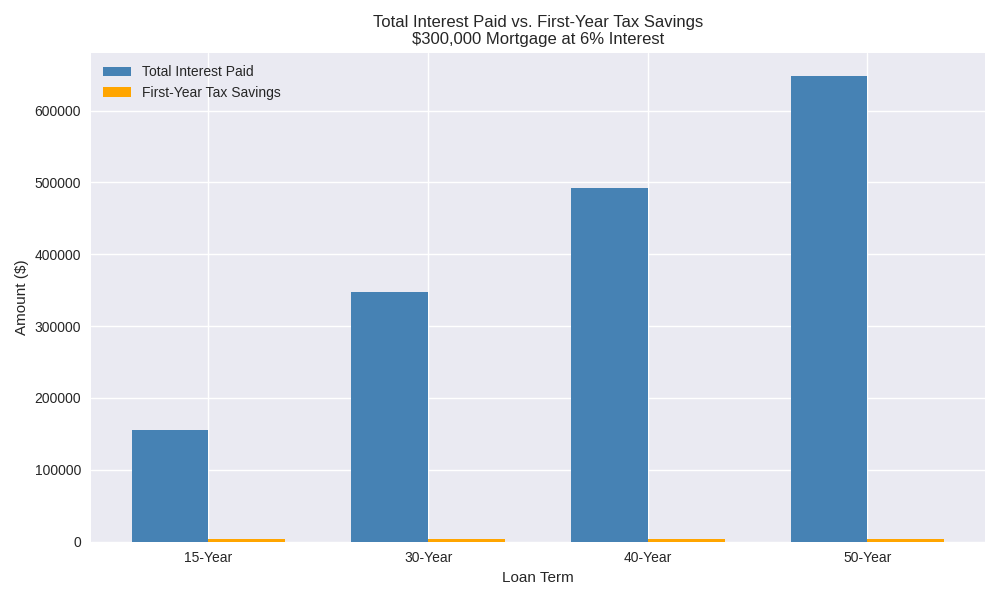
What the Chart Shows
- Blue bars = Total interest paid over the life of the loan
- Orange bars = First-year tax savings from mortgage interest deduction (22% bracket)
- Key Insight: While tax savings are nearly identical across terms (~$3,900 in year one), the interest burden skyrockets as the loan term lengthens.
Breakdown
- 15-Year Loan: ~$155k interest vs. ~$3.9k tax savings → best for wealth-building.
- 30-Year Loan: ~$348k interest vs. ~$3.95k tax savings → balanced but costly.
- 40-Year Loan: ~$492k interest vs. ~$3.96k tax savings → affordability trade-off.
- 50-Year Loan: ~$648k interest vs. ~$3.96k tax savings → tax benefit dwarfed by debt.
Takeaway
The chart makes it clear: tax deductions don’t scale with the exploding interest costs. The 50-year mortgage offers extended deductions, but the long-term debt burden far outweighs the benefit.
BEST TIME TO SELL A HOUSE
Best Time to Sell a House: Seasonal Insights for Maximum Profit
Is there really a “best” time to sell a house? The short answer: Yes—but it depends.
While market trends suggest that spring and summer are generally the most favorable seasons, the ideal time to sell varies based on location, competition, and preparation. Let’s break down the best times to list your home, regional considerations, and key strategies to maximize your sale.
Why Timing Matters in Real Estate
Real estate markets fluctuate with the seasons, influenced by weather, buyer demand, and even school schedules. However, the “best” time isn’t universal—warmer states like Texas, Florida, and Southern California often see stronger winter sales, while colder regions peak in spring and summer.
Data shows that homes sell faster and at higher prices during peak seasons, but simply listing at the “right” time isn’t enough. You’ll also need:
✔ Proper staging and repairs
✔ Competitive pricing
✔ A skilled real estate agent (if needed)
Now, let’s explore how each season impacts home sales.
Timing your home sale right can mean thousands more in profit—or a faster closing. But the “best” time depends heavily on your local market. Below, we break down seasonal trends in key U.S. cities, including price premiums, days on market, and competition levels, plus interactive tools to track your neighborhood’s trends.
Winter: A Niche Opportunity
Best for: Warm-weather markets (Florida, Arizona) or highly desirable homes
Why? Inventory drops, but serious buyers (relocations, investors) are still looking.
Key Insights:
-
Fewer listings mean less competition.
-
Holiday-motivated buyers may move faster.
Pro Tip: If selling in winter, highlight energy efficiency (good heating, insulation) and keep walkways clear for showings.
Live Market Trackers: Check Your Local Trends
Regional Breakdowns: When to Sell for Max Profit
Northeast (Peak: April–June)
| City | Best Month | Price Premium | Avg. DOM | Key Strategy |
| New York, NY | May | +8.5% | 32 days | List condos before Memorial Day to avoid summer slowdown |
| Boston, MA | April | +7.2% | 29 days | Target academic hires near Harvard/MIT |
| Philadelphia, PA | March | +5.8% | 41 days | Staged row homes sell 12% faster |
Midwest (Peak: May–July)
| City | Best Month | Price Premium | Avg. DOM | Key Strategy |
| Chicago, IL | June | +6.4% | 25 days | Price 1–2% below market to spark bidding wars |
| Minneapolis, MN | May | +5.1% | 38 days | Highlight winter-ready features |
South (Varies: Winter in FL, Spring in TX)
| City | Best Month | Price Premium | Avg. DOM | Key Strategy |
| Miami, FL | January | +9.7% | 22 days | Waterfront peaks Dec–Feb |
| Dallas, TX | April | +5.9% | 23 days | Avoid August (DOM jumps 47 days) |
West (Spring in CA, Winter in AZ)
| City | Best Month | Price Premium | Avg. DOM | Key Strategy |
| Los Angeles, CA | May | +7.8% | 42 days | Coastal homes sell 30% faster |
| Phoenix, AZ | December | +6.4% | 27 days | List by Thanksgiving |
3 Rules to Outsmart Seasonal Trends
-
- Price Smarter Homes priced 1–3% below market in slow seasons sell 17% faster (Redfin)
-
- Stage Strategically Seasonal staging (e.g., pool towels in summer) increases offers by 3–5% (NAR)
-
- Track Hyperlocal Data Check Redfin’s “Hot Homes” for bidding war rates
Final Takeaway
While spring/summer dominate nationally, your ZIP code’s data matters more. Use the tools above to sell smart in any season.
How Long does it take to Sell a House
How Long Does It Take to Sell a House
While the average real estate transaction can be completed in less than two weeks, selling a house can take much longer depending on the circumstances and the location of your property. Creating an effective strategy for marketing and staging your home properly before listing it for sale can be beneficial when you wish to sell your property as soon as possible.
What to Know If You Want to Sell Your House Quickly
It is important to understand that not all homes will sell quickly, and if you want to avoid losing out on a large sum of money you should act quickly when you notice that your home is not selling. There are a number of ways to list your home for sale; you will find that once you have listed your property in the right manner, you can usually get back to making improvements and use the extra money to either buy back your home or make improvements that will increase the value of your home. You should also bear in mind that you may be able to buy your home at a much lower price if you take care of some repairs and renovations before you list it for sale.
Another important factor when it comes to how long does it take to sell a house is the curb appeal of the property. Most buyers are looking for homes that are in good shape and that have attractive lawns and gardens. The appearance of a property and its curb appeal is the biggest determining factor in whether a home sells or not. In most cases, buyers will drive past a home if it has appealing exterior features but it is ugly inside. Buyers want to buy a home that is attractive but safe and secure.
Houses that need work generally sell faster than houses that are just new. Houses that need to be painted and repaired tend to sell quickly. A real estate agent can show your property so that you know what your next step should be. It is important that you do not get carried away by the offers you see for the home that you want to purchase. Make sure that you get a professional inspection of your home to find out if the house is in good condition.
You also need to get in touch with local buyers when it comes to asking prices for your property. While a real estate agent can provide information on possible buyers, it is up to you to contact buyers on your own to find out what they are thinking about your home. You should keep in mind that potential buyers may be weighing the price of your home against other homes in the area, so don’t make the mistake of pricing your home too high or too low. You should also check the market value of nearby properties in the immediate area and compare it with your home’s value.
Explore the Market
Another thing that can help you determine how long does it take to sell a house is how the housing market is doing. The better the market temperature is where you intend to list your property, the faster it will take to sell. Usually, sellers want to get rid of their existing inventory as quickly as possible in order to make room for new inventory. It will take some time for your home to adjust to the current market temperature but once it does, it should be faster than if you were trying to sell it at a later date.
One of the best ways how long does it take to sell a house fast is to hire professional assistance. There are several different real estate agents who can help sellers sell their houses fast. Real estate agents are well versed in all aspects of selling houses and will do everything within their power to help you sell your home.
If you need help with how long it takes to sell a house then you should be looking for an experienced real estate agent with a proven track record in helping people sell their homes. Do not neglect to research the market before choosing an agent so that you make the best choice possible for you and your family. Once you have found an experienced real estate agent, you can rest assured that selling your home will be a very straightforward process.
What to Do to Sell a House Faster
There are several ways for selling a home fast, but only when you short on cash do you have to go the extra mile. Get a storage unit out of your basement and pack away any large or extra belongings or large bulky furnishings that are causing your rooms to look messy, overcrowded or untidy. Do not store all your personal belongings in boxes, you need to leave a few out to make room for possible future purchases. This is a good way to start the sale of your home.
When it comes to repairs, make sure that you do not get carried away with the price of the repairs. Some people fall in love with houses that have perfect structures and interiors but do not realize that they could easily cost them more money in the long run. Ask your real estate agent to get you an estimate for the repairs, after all, they are doing a great job on your property.
Prospective buyers will be cautious and the level of “investment value” of the house will decline. If you accept this offer, keep in mind that there are always buyers out there who will pay cash for houses that need repairs. Even if the repairs amount to less than half of the purchase price, your offer probably will be rejected.
So don’t let anyone tell you that you can’t sell a house fast if you want to move on with your life. People want to get their homes sold, but there are other real estate markets that we would rather be in. If you take your time and really think about what you need from this experience, you should be able to sell a house fast. All it takes is some careful planning and the willingness to take massive action now while the market is still very hot.
Find The Value Of Your Home
Best Websites to Find the Value of Your Home (Reviewed and Compared)
Whether you’re thinking of selling your home, refinancing your mortgage, buying an investment property, or you’re just plain curious — knowing your home’s value is key. But what’s the real intent behind someone searching for a home’s value?
In most cases, people want to know the value of a property because they’re:
- Considering selling and want to price it right
- Looking to buy and want to compare prices
- Refinancing or taking out a home equity loan
- Evaluating rental income potential
- Appealing property taxes
- Planning renovations and want to understand ROI
Whatever your reason, online home valuation tools can provide a fast, free starting point. Below, we’ve reviewed and compared some of the best websites for finding out what your home is worth online.
Zillow
- Cost: Free
- Accuracy: Moderate
- Best For: Instant estimates and browsing nearby listings
Zillow’s Zestimate tool is arguably the most well-known online home valuation resource. With a massive database and easy-to-use app, Zillow offers quick property value estimates and allows users to browse nearby homes for sale or rent. It also lets you claim and update your property to improve accuracy. However, Zestimate figures can sometimes be off by 5–10% depending on local data.
Redfin
- Cost: Free
- Accuracy: High (uses MLS data)
- Best For: Accurate pricing and market trends
Redfin offers one of the most accurate online home valuation tools, using up-to-date MLS (Multiple Listing Service) data. You can get a detailed look at comparable homes, recent sales, and market activity. Their user interface is clean and fast, and you can connect directly with Redfin agents for a more thorough analysis.
Trulia
- Cost: Free
- Accuracy: Moderate
- Best For: Neighborhood data and affordability insights
Trulia focuses more on lifestyle factors. It gives home value estimates along with local demographic info, school ratings, crime maps, and more. Their affordability calculator is a helpful tool for understanding monthly costs beyond the mortgage — like insurance and taxes. Unlike Zillow or Redfin, Trulia often directs users to connect with agents for detailed info.
Realtor.com
- Cost: Free
- Accuracy: High (MLS-backed)
- Best For: Filtered, detailed property searches
Backed by the National Association of Realtors, Realtor.com gives users access to detailed MLS listings. It allows advanced filtering by price, square footage, lot size, and more. While it may show many agent-promoted listings, the site’s depth of search tools and map overlays make it useful for buyers and sellers alike.
RE/MAX
- Cost: Free
- Accuracy: Moderate
- Best For: Demographic insights and school ratings
RE/MAX, a well-known real estate company, offers more than just listings. Its platform provides data about local schools, crime rates, and demographics. This can be helpful if you’re considering a move and want to ensure the area aligns with your lifestyle or family needs.
Eppraisal
- Cost: Free
- Accuracy: Moderate
- Best For: Side-by-side comparison of multiple estimates
Eppraisal gives users estimated home values based on data from various sources, including public records. It also compares values across different platforms so you get a broader perspective. The site includes extra info on local schools, cost of living, and financial data like loan rates and income stats.
Chase Home Value Estimator
- Cost: Free
- Accuracy: Basic
- Best For: Quick refinance estimates
Chase Bank’s mortgage division offers a simple home value estimator. Just enter your address to see a basic value range based on surrounding sales. While it lacks visuals, photos, or detailed property info, it’s useful if you’re a Chase customer or considering a refinance and want a ballpark idea fast.
Comparison Table
| Website | Cost | Accuracy | Unique Features | Best For |
|---|---|---|---|---|
| Zillow | Free | Moderate | Zestimate, easy interface | Fast estimates, broad searches |
| Redfin | Free | High | MLS data, live updates | Accurate comps and pricing |
| Trulia | Free | Moderate | Lifestyle & affordability data | Neighborhood insights |
| Realtor.com | Free | High | Filtered MLS listings | Detailed property searches |
| RE/MAX | Free | Moderate | School and demographic info | Families evaluating neighborhoods |
| Eppraisal | Free | Moderate | Multi-site value comparisons | Broad valuation perspective |
| Chase | Free | Basic | Bank-driven estimate tool | Quick refinance checks |
Final Thoughts
Online home valuation tools are a great place to start, but they don’t replace a professional appraisal or local real estate agent’s insights. Use them to get a general idea, then dig deeper if you’re planning to sell, buy, or refinance.
Want the most accurate home value? Consider contacting a local realtor or ordering a professional appraisal.
Related Topics
- How Long Does It Take To Sell A House
- Best Time To Sell A House
- Sell A House By Owner
- Home Listings by Zip Code
- Ask a Home Repair Question to an Expert
Copyright © 2025 – All Rights Reserved.
Disclaimer: This article is for informational purposes only. Website accuracy and availability may change.
Escrow
When you sell your house, the escrow process begins. The escrow company acts as a neutral third party and holds onto funds, such as the down payment and closing costs, until all of the terms of the sale have been met by both the buyer and the seller. Once the terms have been met, the escrow company will release the funds to the appropriate parties and the sale of the house will be complete.
When you sell your house, the escrow process begins. The escrow company, which acts as a neutral third party, holds onto funds, such as the down payment and closing costs, until all of the terms of the sale have been met by both the buyer and the seller. Once all the terms have been met, the escrow company will release the funds to the appropriate parties and the sale of the house will be complete.
As a seller, you will typically be responsible for paying certain closing costs, such as commission for your real estate agent and transfer taxes. The escrow company will subtract these costs from the proceeds of the sale before releasing the remaining funds to you.
It is good to check beforehand the escrow agreement or the closing statement to make sure the amounts and the distribution of the funds are correct.
When you sell your house, the escrow company, which acts as a neutral third party, holds onto the money in escrow until all of the terms of the sale have been met by both the buyer and the seller. Once all the terms have been met, the escrow company will distribute the funds according to the terms of the sale agreement.
The money in escrow is typically used to pay for expenses associated with the sale of the property, such as closing costs, commission for the real estate agent, and any outstanding mortgages or liens on the property.
As the seller, you will typically receive the remaining funds after closing costs and other expenses have been paid out of the escrow account. The exact distribution of funds will depend on the terms of the sale and the escrow agreement. It is important to review the escrow agreement and the closing statement carefully to ensure that the amounts and distribution of funds are correct before signing and closing the sale.
When you sell your house, the escrow process begins. The escrow company acts as a neutral third party and holds onto funds, such as the down payment and closing costs, until all of the terms of the sale have been met by both the buyer and the seller. Once the terms have been met, the escrow company will release the funds to the appropriate parties and the sale of the house will be complete.
As a seller, you will typically be responsible for paying certain closing costs, such as commission for your real estate agent and transfer taxes. The escrow company will subtract these costs from the proceeds of the sale before releasing the remaining funds to you.
The escrow process is typically managed by a professional escrow agent, who will guide you through the process, and ensure that all the conditions and requirements of the sale are met before the closing. Once all the conditions are met, the escrow will be closed, and the ownership of the property will be transferred to the buyer, and the escrow process is completed.
When a property is in escrow, it means that a neutral third-party, typically an escrow company, holds onto funds and documents related to the sale of the property until all of the terms of the sale have been met by both the buyer and the seller.
Typically, the following items are included in escrow:
- The purchase contract and any other agreements related to the sale of the property
- The down payment and closing costs from the buyer
- Any outstanding mortgages or liens on the property, to be paid off at closing
- Proof of property insurance
- Any required disclosures or inspections
- Any other documents or funds required for the sale to be completed
The exact items that are included in escrow will depend on the terms of the sale and the escrow agreement. The escrow agent will ensure that all necessary documents and funds are received and in order before the closing.
- The purchase contract and any other agreements related to the sale of the property: This includes all the terms and conditions agreed between the buyer and the seller. It includes the purchase price, closing date, contingencies, and any other agreements, like home warranty and repairs.
- The down payment and closing costs from the buyer: The buyer will typically put a certain amount of money into escrow as a down payment on the property. The closing costs are the expenses associated with the sale of the property.
- Any outstanding mortgages or liens on the property, to be paid off at closing: If there are any mortgages or liens on the property, the escrow agent will ensure that they are paid off at closing so that the property can be transferred free and clear to the new owner.
- Proof of property insurance: The buyer will typically be required to provide proof of property insurance.
- Any required disclosures or inspections: Depending on the state, there may be certain disclosures that the seller is required to provide to the buyer, such as information about the condition of the property or any known defects. Inspections may also be required to ensure that the property is in good condition.
- Any other documents or funds required for the sale to be completed: The escrow agent will ensure that all necessary documents and funds are received and in order before the closing. This may include title reports, deeds, and other legal documents.
Who usually handles Escrow
An escrow agent or escrow officer typically handles the escrow process. An escrow agent is a neutral third party who holds onto funds and documents related to the sale of a property until all of the terms of the sale have been met by both the buyer and the seller. They are responsible for ensuring that all necessary documents and funds are received and in order before the closing. They also ensure that all the conditions and requirements of the sale are met before the closing.
An escrow agent can be affiliated with a title company, escrow company, or a bank. Some real estate agents also have their own escrow department. The escrow agent will guide the buyers and sellers through the escrow process, and when all the conditions are met, the escrow will be closed, and the ownership of the property will be transferred to the buyer, and the escrow process is completed.
Realtor vs No Realtor
When buying a house, many people wonder whether they should have their own realtor. The truth is, having your own realtor can be incredibly beneficial when purchasing a home. Here’s a look at some of the reasons why you may want to consider working with a realtor when buying a house.
First and foremost, a realtor can help you navigate the complex process of buying a home. The home buying process can be overwhelming, with many different steps and a lot of paperwork to complete. A realtor can help you understand the process and guide you through each step, making sure that you’re aware of all the deadlines and requirements. They can also help you find the right home for your needs and budget, by searching for properties that match your criteria, scheduling appointments for you to view properties, and helping you evaluate the pros and cons of each potential home.
A realtor can also help you navigate the financial aspect of buying a home. They can help you understand the different types of loans available, and help you find a lender that will give you the best terms. They can also help you understand what your closing costs will be, and help you negotiate with the seller to reduce these costs. They can help you with the negotiations of the price and help you with the paperwork required.
Realtor can also help you with the home inspection process. A home inspection is an important step in the home buying process, as it allows you to identify any potential issues with the property before you close on the sale. A realtor can help you find a reputable home inspector, schedule the inspection, and interpret the results of the inspection. They can also help you negotiate with the seller to make any necessary repairs or to lower the price of the home if there are significant issues.
Realtors can also help you with the closing process. Closing is the final step in the home buying process, and it can be a bit overwhelming. A realtor can help you understand the paperwork that needs to be completed, and make sure that all the necessary steps are taken to finalize the sale. They can also help you with the title search process, and can help you find a title company that will handle the title search and closing process for you.
Realtors can also help you with the negotiations. They are experts in negotiation and can help you get the best possible deal on your new home. They can help you with price negotiations, closing cost negotiations, and even help you negotiate for certain repairs or upgrades. They can also help you with the contract, making sure that all the terms and conditions are fair and reasonable, and that you understand all the terms and conditions of the contract.
Realtors can also help you with the paperwork. They can help you understand all the paperwork required, and make sure that all the paperwork is completed correctly. They can also help you with the negotiations of the paperwork, making sure that all the terms and conditions are fair and reasonable, and that you understand all the terms and conditions of the contract.
Another benefit of working with a realtor is that they can provide you with valuable insights into the local housing market. A realtor can tell you about current market trends, such as how long homes are staying on the market, and what types of homes are selling quickly. They can also give you an idea of what the housing market is like in the area where you’re looking to buy a home, which can help you make a more informed decision about whether to buy a home now or wait until the market shifts.
Lastly, a realtor can save you time. They have access to all the listings in the area, and can quickly narrow down the search to the homes that fit your criteria. They can also schedule appointments to view
Selling your house without an estate agent, also known as “For Sale by Owner” (FSBO), is becoming increasingly popular as homeowners look to save money on commission fees. However, selling your house without an estate agent can also be a challenging and time-consuming process, and it’s important to weigh the pros and cons before making a decision.
One of the main advantages of selling your house without an estate agent is that you can save a significant amount of money on commission fees. Estate agents typically charge a commission of around 1-2% of the sale price, which can add up to thousands of dollars. By selling your house without an estate agent, you can keep that money in your pocket.
Another advantage of selling your house without an estate agent is that you have more control over the sale process. When you sell your house through an estate agent, you have to rely on them to market your property, set the asking price, and negotiate with potential buyers. By selling your house without an estate agent, you are in charge of all of these aspects, which can give you more peace of mind.
However, there are also several disadvantages to consider when selling your house without an estate agent. One of the main disadvantages is that you will have to do all the work yourself. This includes marketing your property, setting the asking price, negotiating with potential buyers, and dealing with paperwork. This can be a lot of work, and it can be difficult to find the time and energy to do it all yourself.
Another disadvantage of selling your house without an estate agent is that you may not get as much money for your property. Estate agents have a lot of experience in pricing properties and negotiating with buyers, which can help you get the best price for your home. Without an estate agent, you may not be able to get as much money for your property, especially if you are not familiar with the local housing market.
In addition, estate agents have a wide network of contacts and resources that can help you sell your house quickly. They have access to a large pool of potential buyers and can use their professional marketing skills to showcase your property in the best light possible. Without an estate agent, you may struggle to find buyers and may end up waiting longer to sell your house.
Finally, selling your house without an estate agent can also be risky. You will need to be comfortable with the legal side of things, and you will need to make sure that everything is done correctly. If you make any mistakes, it could cost you a lot of money and could even lead to legal issues down the line.
In conclusion, selling your house without an estate agent can be a great way to save money on commission fees, but it can also be a challenging and time-consuming process. Before making a decision, it’s important to weigh the pros and cons and decide if it’s the right choice for you. If you decide to go for it, make sure to do your research and be prepared to put in the time and effort to make the sale a success.